Scientific data on the environmental impact of our personal and collective actions as consumers can make us more aware of our interconnectedness with other living beings. However, data about complex environmental issues are often difficult to relate to and empathize with. In “The Secret Life of…” I had the great opportunity of collaborating in envisioning an interactive experience that stimulates personal and collective reflections on plastic microfibers emissions. This work is lead by Alexandra Fruhstorfer, whose research funds the technical development and material, and Seçil Uğur Yavuz. The experience was shown at the Fashion for Future week in Bolzano (Italy) and the results and reflections will be published and presented at NordiCHI’24 in Uppsala (Sweden). A highlight of this project has definitely being able to collaborate with inspiring people, such as Alexandra, Seçil, and Jakob. “The Secret Life of…” also adds to my personal interest on how data can be used as a design material, and how interactive technologies can provide effective and enjoyable experiences but also long-lasting meaning.
Who Cares about Data?
In the summer of 2022, Trine Rask Nielsen joined us at the Free University of Bolzano for a two-month research stay. She had been doing rich ethnographic work as part of the project with her supervisor, Prof. Naja Holten Møller at the Confronting Data co-lab. She proposed to look at the data with a care perspective, and I was very excited about having the opportunity to do that together. What happened in the next weeks was a great collaboration, where we discussed the paper, the theoretical work, and academic life. In the paper, we investigate how asylum stakeholders enact care as an aspect of asylum casework, and propose that care is enacted by caseworkers in moments of ambivalence, translation, and attentiveness to “new substantial information” relevant for asylum decision-making. The submission was accepted to CSCW journal and received the David D. Martin Award at ECSCW 2023. Here you can read an interview to Trine, and here you find the full paper.
Making invisible data visible
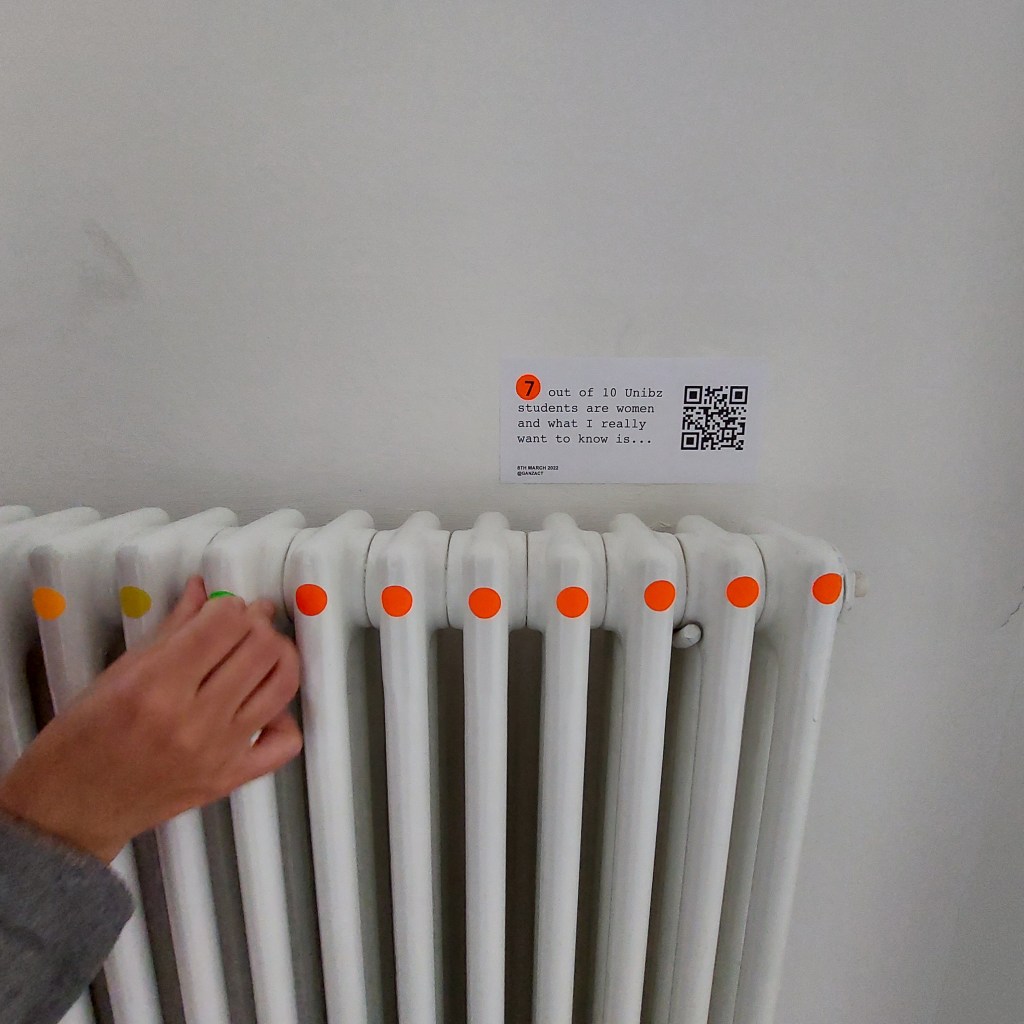
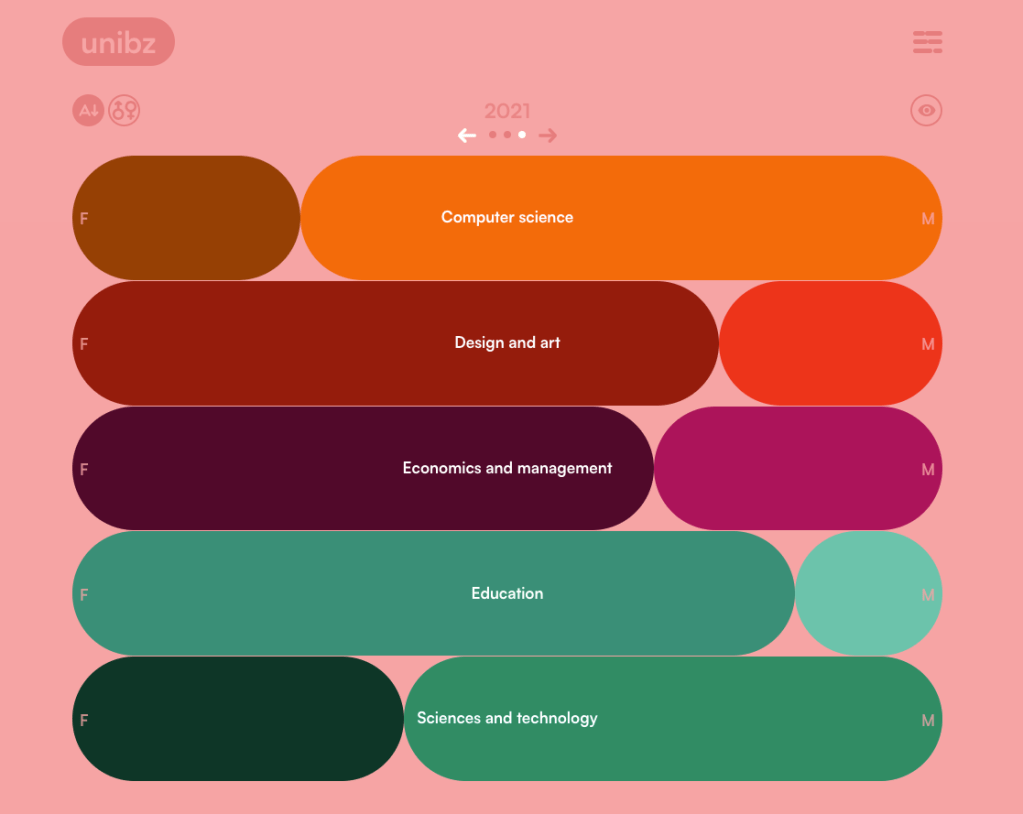
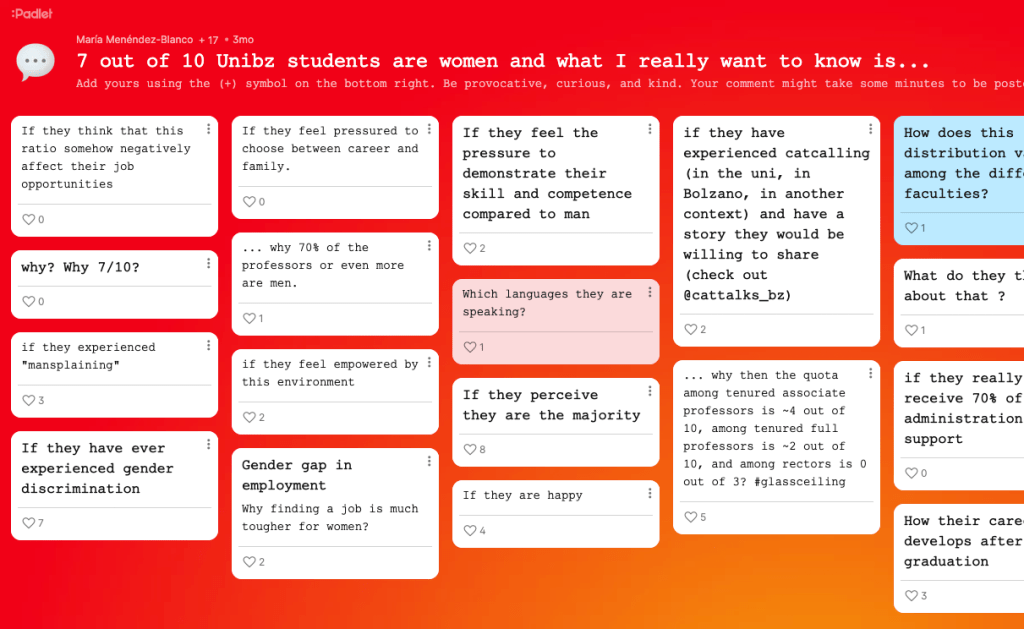
Data represent realities but also create them since they shape what can be considered “facts”. In public institutions, data statistics are used to represent the status of inclusion and diversity, often with an emphasis on gender. However, these data are limited in showing daily experiences and concerns that are key to equity. In this project, Prof. Seçil Ugur Yavuz and I want to make the “invisible data” visible through interactive and participatory actions. Following a feminist approach to Action Research, we collect and share students’ concerns and experiences related to equity through discussions and interactive artifacts. This project is supported by the Free University of Bolzano, and done in collaboration with Sheldon.Studio. To see part of the project visit: invisibledata.project.unibz.it
We wrote a book!
In 2017, the FemTech.dk project kicked off and with it my post-doc position at the Computer Science department of the University of Copenhagen. Previously I had been working on public issues and I was particularly interested in controversies. I was driven by an interest in doing research with activists, civil society, and public officers on issues related to democratic participation. When Pernille Bjørn proposed I work on gender in higher education I thought there was no controversy in there for me – and I couldn’t be more mistaken. As I started to work on FemTech.dk, the project grew on me and I grew with the project. We investigated and experienced the different agendas around diversity. We developed installations, organised events, and workshops aimed to sparkle debate on the gendered narratives in computer science. We wrote many papers, and many of them were rejected. In 2018, Martha Larson invited us to give a keynote at ACM Multimedia, where many people became interested in our work on fostering debates on equity in computer science, and some others thought there was not an issue – they couldn’t be more mistaken. After our presentation, we were invited to write a book on the project, and the result can be openly read here. The book tells about our experience in Denmark trying to open computer science to different backgrounds and interests – it is not about attracting minorities to computer science or teaching them how to code. We chose to include insights about our journey, including failures and successes, and there were many of them. We wrote this book thinking of different audiences including teachers, policymakers, researchers, and journalists – if you work on diversity in higher education we hope you find something in this book for you.
(Re)searching gender
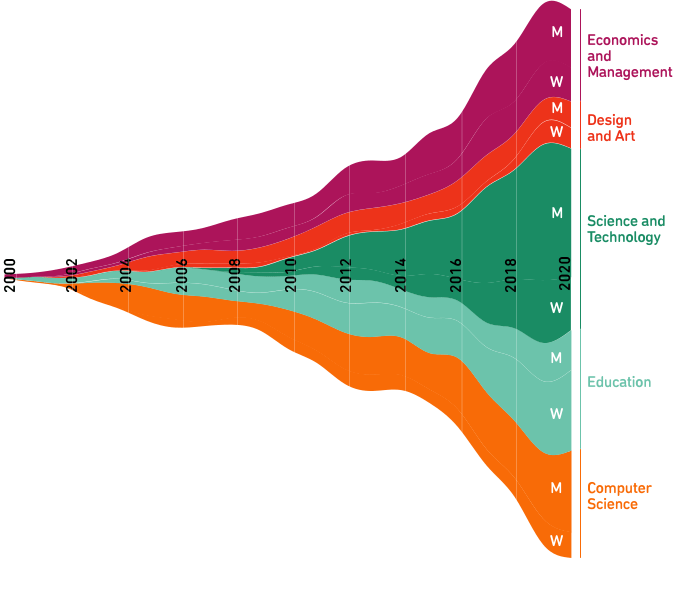
When I joined the Free University of Bolzano I was surprised by the extensive amount of quantitative data on students, researchers, and professors that were openly available on our Intranet. Seeing all these data made me curious to investigate the gender percentages for the different faculties and positions, and what I found did not surprise me. As in most universities around the world, the more senior the position, the lowest the proportion of women. This trend was consistent across all the five faculties, even in those where the percentage of women students in the bachelor programme was up to 80%. Even if unsurprising, I thought that working with these data could add to the ongoing debates on inclusion and diversity at our university, and maybe open it up to the “non-usual suspects”. Indeed, a struggle I have faced when working on diversity in higher education has been to engage those who do not see themselves affected, or think that is something “we have already dealt with”. Throughout the years I have observed that quantitative data sometimes have the fascinating power of gathering the attention of those who otherwise would not care. With all these data and many thoughts, I reached out to Matteo Moretti from Sheldon Studio, who jumped into the project and brought Salto.bz in. That’s how our short collaboration on “(Re)searching gender” was born. In addition, in March 2020 I also organised a film club where we watched movies and discussed gender and intersectional narratives in movies.
Hybrid Interactive Experiences
In May 2020 I was invited to participate in the organisation of the Interactive Experiences track at CHItaly 2021 together with Secil Ugur Yavuz and Jennifer Schubert from the Faculty of Design and Arts of the University of Bolzano. I thought this could be a good opportunity to collaborate with inspiring colleagues while participating in the organisation of (yet one more ;)) research conference. However, the Interactive Experiences turned out to be very different from any other interactive exhibition I had organised. As the months went by, and the Covid-19 pandemic continued hitting the world, we realised that it would be impossible to hold an in-person conference. The conference organisers decided to go for a hybrid conference, as this format could open opportunities for broadening participation. Little we knew about what designing a hybrid interactive exhibition would look like. What followed were three months of a full-time commitment to design and implement an interactive exhibition in Bolzano and online. Thankfully we were not alone in this. The authors of the installations collaborated in adopting and sometimes modifying their prototypes and installations to the hybrid format. The digital and technical chairs and several student volunteers were essential to the implementation of the exhibition on Gather Town. The ACM SIGCHI Development Fund financially supported all the additional, and difficult to anticipate, costs that hybrid exhibitions bring along. The most visible outcome was the hybrid interactive exhibition “(Dis) Assembling Futures”; however, we also gained a lot of knowledge on what it means to design and implement a hybrid interactive installation – and what does “hybrid” means. As I write this text, Secil, Jennifer, and I are putting down our insights into a paper, which we hope will see the light soon.
Digital Platforms for Citizen Participation
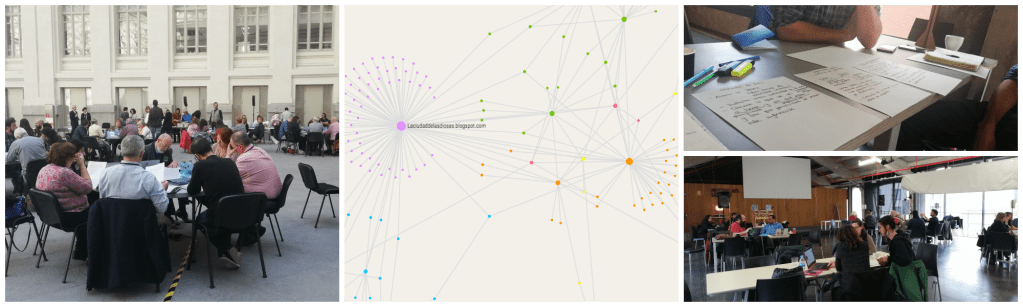
Processes for citizen participation in decision-making seek to open opportunities for people to influence agenda-setting, public budget allocation, or policy-making. In the last years, there is an increasing interest in exploring how digital platforms can support these forms of citizen participation. There are many open questions about citizen participation processes and how they become implemented digitally. What does it mean participate in decision-making processes in issues of public interest? How can digital platforms support democratic forms of participation? Who is invited to participate? In 2019, I visited the PartipaLab at the MediaLab Prado in Madrid. For six months, I collaborated with researchers, citizens, city officers on different projects about participation, technologies, and democracy. Some of the outcomes were report on the sustainability of civic technologies, and a publication on sortition as participation instrument.
Equity in Computing
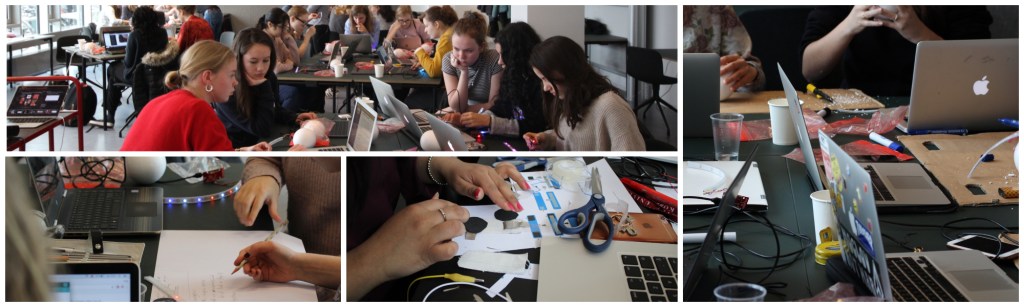
Why is it important to create equal opportunities in computer science? Why do stereotypes matter? How to move from deficit approaches in diversity programmes? Research shows that there are structural and systematic issues that shape how people participate in computer science. However, these pervasive problems can not be addressed holistically, they require concrete interventions. To that purpose, in the last years, I have co-organised many activities, workshops, public events, and talks on equity in computer science. Some of the outcomes are interactive products that open opportunities for discussion and learning. All materials, instructions, and source code are available on FemTech.dk.
Political alignments in Participatory Design
How do political alignments influence how people participate in design projects? How do design affordances shape democratic participation in digital platforms? Based on the four digital democracy positions proposed by L. Dahlberg, we developed a set of cards to discuss the political alignment of participatory design projects. Unpacking how people prefer to participate in projects with a political lens is important because of their design implications. For example, participants who are aligned with deliberative forms of participation might prefer mechanisms such as consensus; while participants who are aligned with rational forms of participation might prefer decisions to be taken through voting. These cards are a design tool that has been proofed to successfully unpack important considerations in several Participatory Design projects.
Representing Matters of Concern: GRACE
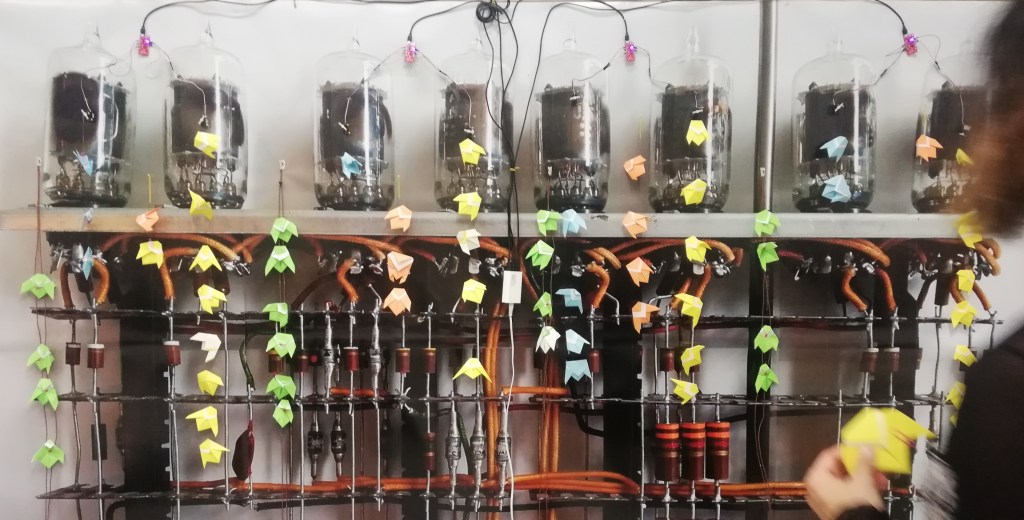
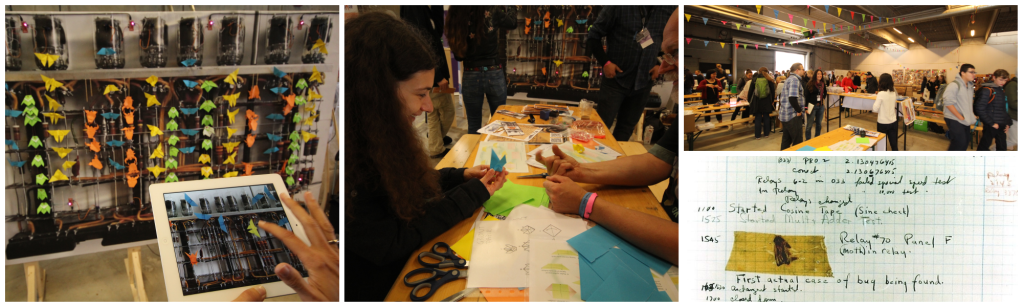
GRACE is an interactive installation designed to celebrate the 70th anniversary of the “first bug ever found” by Grace M. Hooper in 1947. It is a large wooden installation built using origami, microcontrollers, sensors, and actuators with which participants can interact with their mobile phones. Conceptually, GRACE seeks to open up discussions on concerns about equity, gender, and computing. Theoretically, the design is inspired by Latour’s “object-oriented democracy”, which points to two different meanings of the word representation. On the one hand, representing is about the ways to bring legitimate people around a matter of concern (“Who is to be considered?”). The second is about presenting the different views and angles on an object of concern (“What is to be considered?”). Since 2017, more than 1000 people have interacted with the installation in Denmark, the USA, and France.
 Maria Menendez-Blanco